

What a year of hard lessons, strategic pivots, and unexpected clarity taught us about building for the agent era
🎧 Prefer to listen? Hit play below:
There’s a moment in every startup’s life when you stop proving you can work and start proving you can win. For SmythOS, that moment was 2025.
We sat down with our co-founders, CEO Michael Umansky and CTO Alexander De Ridder, for an honest conversation about what this year taught them. No rehearsed talking points. No sanitized corporate speak. Just two founders who’ve been in the trenches, reflecting on the wins, the setbacks, and the hard-earned wisdom that comes from building something in the fastest-moving industry on the planet.
What emerged was something unexpected: a story about humility, about learning to say no, and about why the future of AI belongs to everyone.
“Life Slaps You in the Face”
Alexander has a way of cutting through pretense. When asked what changed most for him in 2025, he didn’t talk about product launches or market positioning. He talked about humility.
“If I ask you, are you a humble person, maybe right off the bat you’ll say, ‘Oh yeah, I’m humble,'” Alexander explained. “And then the more you think about it, the more you realize there’s pride in what you’re doing. Pride in how you react to other people. How dare that person say that to me.”
This isn’t Alexander’s first startup. Both he and Michael have built successful companies before. Years of experience. But 2025 had other plans.
“There’s a moment when you think, ‘I figured it out.’ Poor first-time founder, little do you know. But then life slaps you in the face and says, ‘Nah, you still got a lot to learn.'”
The lesson? No two startups are the same. Just like no two kids are the same.
“I remember when I had young kids and mine were… active,” Alexander laughed. “That’s a nice word. Very active. And this parent with one quiet daughter would come and give me parenting advice. It’s like, yeah, see how that would work with our kids.”
The parallel to startups is clear. You can look at other companies and think you know how things should be done. But it’s not until you’re in the trenches that you see how different every market, every product, every team really is.
The Year SmythOS Found Its Footing
Michael’s take on 2025 is more operational, but equally candid.
“This was the year we figured out how to operate with a lot more clarity and discipline,” he said. “We had to do a lot of work to be customer obsessed. And to really figure out how to find the right customers for where we were going as a company.”
That phrase, “finding the right customers,” might sound like standard business jargon. It’s not. For SmythOS, it represented a fundamental shift in thinking.
In the early days of any startup, there’s a temptation to say yes to everything. Every potential customer, every feature request, every partnership opportunity. But that approach doesn’t scale. And more importantly, it doesn’t lead to the kind of deep customer relationships that actually matter.
“We became better at saying no to things,” Alexander added. “When I say no to things, it creates space and time. And it’s in that time that I find my best work, my most creative work.”
This wasn’t easy for him. “I’m a person that likes to make other people happy,” he admitted. “But even if I wanted to, I couldn’t give everybody the same treatment. And you need to be okay with that.”
The Hardest Decision
Every founder has that moment. The decision that keeps you up at night. For Michael, 2025 brought his.
“We had to make some strategic cuts to cut burn and realign teams around making things tighter,” he said. “That’s never fun. But it made us stronger, faster, and better aligned with where we were going.”
There’s a tendency in startup culture to celebrate only the wins. But the truth is, difficult decisions often unlock the biggest growth. Cutting isn’t failure. Sometimes it’s clarity.
Michael framed it this way: the cuts helped SmythOS focus on what mattered. And what mattered became increasingly clear as the year progressed.
Riding the Wave (Not Creating It)
Here’s where things get interesting.
Alexander has always been a big thinker. In his younger years, he was a competitive StarCraft player who loved the Zerg strategy. Cover the whole map. Conquer the world. That mentality carried into his startup career.
“My mind by default cannot think in terms of making a nice company that plays well with others,” he explained. “I’m going to build something and conquer the world.”
But 2025 forced a rethinking of that approach.
“The assumption was I would create a category this year. The market forced me to rethink that,” Alexander said. “The market is moving so fast. There’s almost no time to own a category.”
This is a profound observation. In AI, everything that used to take ten years now takes one year. What used to take three years takes five months. What took six months now takes a single month.
“You can’t really create the wave,” Alexander continued. “I would argue that even OpenAI, who created the wave with the ChatGPT launch, is now just riding the wave along with everybody else.”
The implication for SmythOS? Stop trying to own the wave. Start riding it alongside everyone else. Be interoperable. Work well with others.
“If you’re not riding the wave, you’re going to be crushed by it.”
The Surprise That Changed Everything
Every founder has assumptions about what customers want. Some get validated. Some get shattered.
For Michael, the biggest surprise of 2025 came from an unexpected source: the makers of things.
“I was surprised by the interest we got from OEMs,” he said. “What they realized, and this was what I was super excited about, was that our customers didn’t just want to use SmythOS in a SaaS environment. They wanted to package it and ship it and deploy it directly onto devices. Cars. Computers. Medical devices.”
This completely shifted how Michael thought about the market. SmythOS wasn’t just building agent infrastructure. They were building embodied AI infrastructure. The foundation that would power AI in the physical world.
Alexander had predicted this years ago. Just like he predicted in 2023 that AI agents would be everywhere within eighteen months. And just like that prediction came true, he now believes embodied AI infrastructure will define the next era.
“AI agents will run everywhere,” Alexander said. “Internet of things. Devices. And they will all mesh and network.”
What We Got Right Early
Looking three to five years ahead (which, as Michael pointed out, might as well be twenty years given how fast things move), both founders have strong opinions about what they believe SmythOS got right before anyone else.
Alexander’s list is technical and bold:
Marketing to AI agents as primary customers. Back in 2023, Alexander went on stage and explained that in the future, you’ll market to AI agents because humans will rely on them for shopping and everything else. Just like we rely on GPS today. “I have tape,” he said. “You can watch my keynotes.”
AI agents running everywhere. Not just in the cloud, but on your thermostat, in your car, on your laptop, on Android, iOS, everywhere. And they’ll all mesh and network together.
Language models as brains in jars. This one’s fascinating. Alexander believes the wall that AI models hit is because they need a body to live in. Physical twins or virtual twins. “AI is sometimes so, so dumb on things that seem obvious,” he explained. “The reason is that it did not grow up in the same world. We share a physical world with dogs. That’s why a dog can inhabit that world. AI is really smart in its own world. But really dumb in our physical world.”
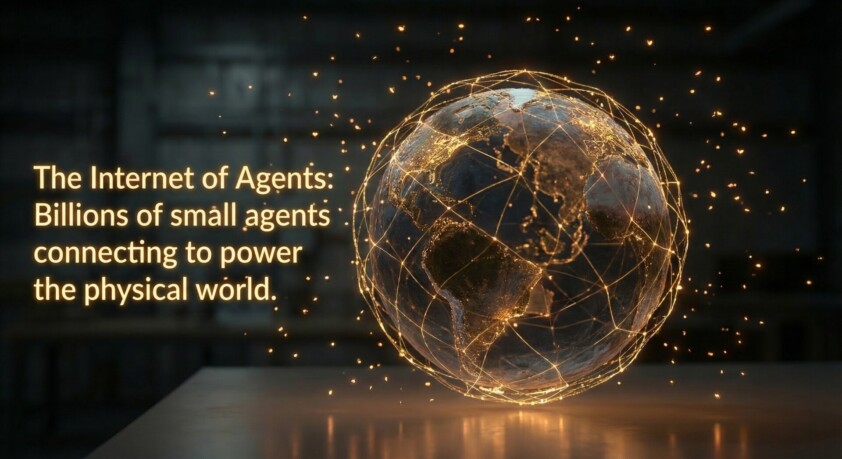
Not one genius AI, but billions of small ones. “Three, four, five years ago, we consistently said it’s not going to be a single genius AI. It’s going to be countless billions of small ones working together. The Internet of Agents.”
A Fight for All Humanity
But the thing both founders believe they got most right? It’s not technical at all.
It’s opening up their technology.
“This cannot be said enough,” Alexander emphasized. “When the dust settles, what I hope people say we got right early is that we made our technology open source.”
This wasn’t a marketing decision. It was a moral one.
“The truth is, AI is not going to get everything right,” Alexander acknowledged. “The future is going to have a lot of pluses and a lot of minuses. But the companies that are recognized for doing the right thing for humanity, I think they’ll have to move to a more open world regardless.”
Michael echoed this sentiment when discussing SmythOS’s mission and values. “These weren’t things we just picked out of the sky,” he said. “They’re things we really believe in.”
Innovation. Customer centricity. Being driven. And social responsibility.
“What I hope is that when people think about SmythOS three or five years from now, it’s that we understood agentic AI wasn’t just about features. It was about impact. Building things people never thought would be possible. Doing it with human beings in mind.”
A Sober Warning
Alexander didn’t pull punches when discussing the social impact of AI. And honestly, it’s refreshing to hear a founder be this direct.
“You know how people, especially a year ago, were saying ‘AI won’t take your job, people using AI will take your job’?” he asked. “There’s some truth to that. But it’s also kind of window washing. Dressing up the problem.”
The truth, he believes, is starker.
“Eventually we hope it will be fine. But in between now and then, there’s going to be massive social impact. Lots of people will be impacted with their jobs.”
He drew a parallel to social media’s impact on teenagers’ mental health. “We learned our lesson. Never again. It’s like a 9/11 moment. We ruined a whole generation of kids with social anxiety. My kids’ high school finally started banning cell phones.”
And then, his point landed: “And then we go around and take this technology that is a thousand times more impactful than social media was. And we’re just rushing it out.”
This is why open source matters to SmythOS. Not as a business strategy, but as a moral imperative.
“AI did not discriminate based on where people were in terms of access to our technology or training. Give them the tools so they can play a role in this new economy.”
Looking Forward to 2026
So what’s next?
For SmythOS, the focus is clear. Execution. Orchestration. Governance. Observability.
“In 2026, we’re going to prioritize the execution, orchestration, governance, observability layer of SmythOS,” Alexander explained. “Less than the authoring layer, which is already really good.”
This is a deliberate choice. Code is becoming commoditized quickly. Vibe coding will mature. The authoring side of agents is getting easier by the day.
But the hard problems? Making agents reliable, observable, governable, and portable across hardware? That’s where SmythOS is doubling down.
Michael put it simply: “It’s not about being embedded. It’s about being embodied. What we’ve built and where we’re going with our open source repo will empower makers to build the base of everything and plug into whatever they need.”
You’ve Got a Friend in SmythOS
As the conversation wrapped up, Alexander offered a final thought that perfectly captures where SmythOS stands heading into the new year.
“The first thing that came to mind was Toy Story,” he said with a smile. “‘You’ve got a friend in me.’ It seemed a little bit awkward. But then I thought, if you’re going to build, build with an open source stack. Build with a company that cares.”
SmythOS has a community. They want you to be successful. The world is still figuring out how to make AI agents safe, secure, reliable, observable, and maintainable. It’s a journey.
“We’re on that journey with you,” Alexander said. “We’re listening. We’re learning. We’re iterating rapidly. Let’s do this together.”
Our team is standing by. Let us know how we can help you with your Agentic AI needs.This article is based on a year-end interview with SmythOS co-founders Michael Umansky(CEO) and Alexander De Ridder (CTO), conducted by Amber Graner, Head of Community and DevRel.