
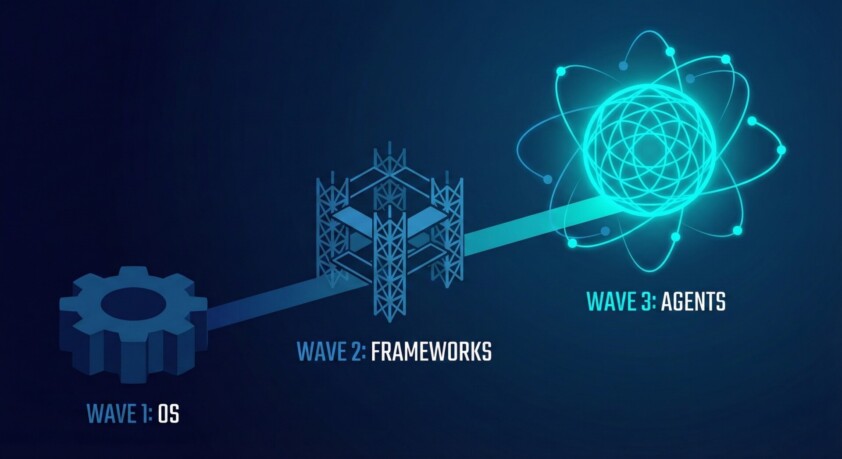

Open source has always been about more than code. It’s been about who gets to participate in building the future. The first wave gave us operating systems like Linux. The second wave gave us frameworks like React, TensorFlow, and Kubernetes. But the third wave is where things truly differ.
The next generation of open source won’t be libraries you call. It’ll be agents that call themselves.
We’re talking about autonomous systems that reason through problems, use tools on their own, and collaborate with other agents to get work done. This isn’t some far-off prediction. Gartner has positioned agentic AI as the number one strategic technology trend for 2025, indicating that autonomous systems represent the most significant technology development affecting enterprise strategy.
The global open source software market is expected to grow from $45.66 billion in 2025 to $172.69 billion by 2033, according to Business Research Insights. But here’s what most analysis misses: the nature of what’s being built is fundamentally changing.
Frameworks help you write software. Agents are software that writes itself.
Why Agents Are Replacing Frameworks
Traditional open-source projects provided developers with tools. You chain prompts with one library, train models with another, and orchestrate containers with a third. These are powerful, but they share a common trait: they wait for you to tell them what to do.
Agentic systems flip that relationship entirely.
Gartner predicts that by 2027, 86% of companies will be operational with AI agents. McKinsey’s 2025 State of AI report found that 23% of organizations are already scaling agentic AI systems, with another 39% experimenting with them.
Why such explosive growth? Enterprises are realizing the bottleneck isn’t intelligence. It’s agency. We have models that reason at the PhD level. What we lack is a reliable infrastructure to let them act. This is exactly why SmythOS built an agent operating system from the ground up, designed specifically for AI agent workloads.
The 95% Failure Problem
Here’s a statistic that should make everyone uncomfortable. MIT’s NANDA Initiative published research showing that, despite $30-40 billion in enterprise AI spending, 95% of pilots delivered no measurable impact on profit and loss (P&L). Only 5% created significant value.
Harvard Business Review covered the findings, noting that leaders are repeating the mistakes of the digital transformation era by funding scattered pilots that don’t scale.
Think about what happens when an AI agent has access to your CRM, email, calendar, and billing system. A single confident mistake can result in sending the wrong invoices or scheduling meetings with the wrong people. The damage isn’t contained like a chatbot hallucination.
This is why the focus of the open source community is shifting. We don’t need more frameworks to build agents. We need infrastructure to run them safely.
What Production Agent Infrastructure Requires
Traditional frameworks share traits that made sense for their era: modularity, extensibility, and developer control. Agentic infrastructure demands something more. It demands “safe autonomy” because you’re giving systems the ability to act on their own.
- Stateful Execution. Unlike stateless function calls, agents need memory. They must remember what they were doing, what they’ve learned, and what context matters. SmythOS SRE provides built-in memory management that maintains agent state across sessions and workflows.
- Security at the Kernel Level. When an agent can take actions, every capability becomes a potential attack surface. SmythOS implements AES-256 encrypted vaults where secrets never touch disk or code, eliminating credential leaks at the architecture level.
- Observability by Default. You can’t trust what you can’t see. Gartner’s survey found that 45% of leaders in high AI maturity organizations keep initiatives in production for three years or more because they built proper observability from the start.
- Interoperability Without Lock-in. Today’s best model might be tomorrow’s legacy system. SmythOS lets you switch AI models on the fly without rebuilds or redeploys.
Why Open Source Wins
There’s a strategic reason why agentic infrastructure needs to be open source, and it goes beyond philosophy.
When you deploy an AI agent with real authority to act on behalf of your business, you’re introducing opacity risk. If you can’t inspect the code that governs how your agent makes decisions, you’re operating blind.
According to Mordor Intelligence, 96% of organizations are maintaining or expanding their use of open source software. Gartner estimates that only about 130 of the thousands of agentic AI vendors are real, with many engaging in “agent washing” by rebranding existing products. Open source cuts through this confusion because you can inspect exactly what you’re getting.
This is precisely why SmythOS open-sourced the SmythOS Runtime Environment (SRE) under the MIT license. Transparency and portability aren’t features to add later. They’re foundational requirements.
The Architecture of Trust
Building trustworthy autonomous systems requires rethinking software structure at a fundamental level. When an agent needs to process sensitive data, the flow is dynamic. The agent decides what data it needs based on its current task.
This demands new architectural patterns:
- Air-gapped components that can’t leak information to each other
- Sandboxed execution environments that prevent unauthorized access
- Permission systems that scope capabilities to specific tasks
SmythOS architecture natively air gaps components on a “need to know” basis. Components act independently with zero data leakage. This isn’t a feature added on top of it. It’s built into the foundation.
The Agent Economy Is Coming
The transition from frameworks to autonomous systems will reshape how we think about software itself.
Today, we talk about “deploying applications.” Tomorrow, we’ll talk about “deploying agents.” Today, we measure uptime and latency. Tomorrow, we’ll measure decision quality and goal achievement.
Gartner predicts that agentic AI could drive approximately 30% of enterprise application software revenue by 2035, surpassing $450 billion in value. That’s not a niche technology. That’s a new foundation for how business software works.
The open-source community has always excelled at building infrastructure. We built the internet’s plumbing with TCP/IP, HTTP, and DNS. We built the cloud’s foundation with Linux, Docker, and Kubernetes. Now we’re building the backbone of the agent economy.
SmythOS has built a community of developers who build agents that deliver real ROI. Star SmythOS on GitHub. Our team is standing by. Please let us know how we can assist you with your Agentic AI needs.