
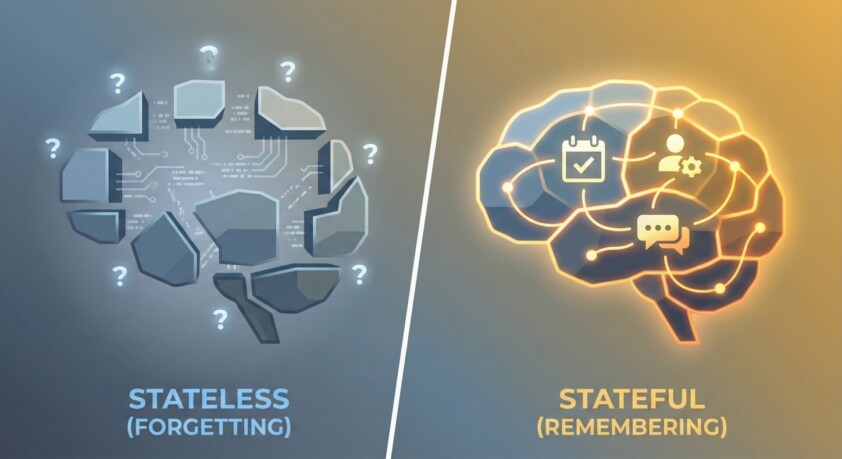

How stateful agent systems change what’s possible in long-term customer relationships.
Your AI agent just had a great conversation with a customer. They explained their preferences, shared their budget, and walked through their workflow. Then they came back the next day.
And your agent had no idea who they were.
This isn’t a bug. It’s how most AI systems work. And it’s costing businesses billions.
The Stateless Reality Nobody Talks About
Here’s something that surprises most people: large language models don’t actually remember anything. Every request is completely independent. According to IBM’s research on AI agent memory, LLMs “operate within short context windows and stateless APIs,” meaning yesterday’s conversation might as well have never happened.
Think about that for a second. You’ve invested in AI to improve customer relationships, but your system treats every returning customer like a stranger.
The MIT NANDA State of AI in Business 2025 report puts this problem in stark terms. Their research found that 95% of enterprise AI pilots fail to deliver measurable returns. The core reason? Most GenAI systems “do not retain feedback, adapt to context, or improve over time.”
One interviewee in the MIT study explained it perfectly: “It’s excellent for brainstorming and first drafts, but it doesn’t retain knowledge of client preferences or learn from previous edits. It repeats the same mistakes and requires extensive context input for each session.”
Sound familiar?
Why Memory Actually Matters
Let’s be honest about what we’re losing here.
A support agent that can’t remember a customer’s previous issues forces them to repeat themselves. Every. Single. Time. A sales assistant that forgets pricing discussions from last week makes your team look disorganized. An onboarding bot that can’t recall where a user left off creates friction instead of reducing it.
The RAND Corporation’s analysis found that over 80% of AI projects fail to reach meaningful production deployment. That’s twice the failure rate of non-AI technology projects. And a significant chunk of those failures trace back to systems that can’t maintain state across interactions.
According to S&P Global’s 2025 survey, 42% of companies abandoned most of their AI initiatives this year. That’s up from just 17% in 2024. The average organization scrapped 46% of AI proofs-of-concept before they reached production.
Memory isn’t just a nice feature; it’s essential. It’s the difference between an AI demo and an AI product.
What Stateful Actually Means
When we talk about stateful agent systems, we’re describing something fundamentally different from the typical chatbot experience.
A stateful system maintains context across sessions. It remembers that Sarah prefers direct flights. It knows that your enterprise customer has a $750K budget (updated from last quarter’s $500K). It recalls which troubleshooting steps have already been tried, so it doesn’t suggest them again.
The technical architecture behind this involves multiple layers. Short-term memory handles immediate context within a conversation. Long-term memory persists knowledge across different sessions, typically stored in databases, knowledge graphs, or vector embeddings. Redis’s research on AI agent memory describes this as “multi-tier caching” that enables agents to reference past interactions intelligently.
But here’s what many builders miss: memory management isn’t just about storage. It’s about knowing what to keep, what to forget, and how to retrieve relevant context at exactly the right moment. Too much memory creates noise. Too little breaks continuity.
The systems that work, the 5% that MIT found actually delivering value, have figured out this balance.
The Production Gap Nobody Bridges
You can build a memory-capable prototype in a weekend. Getting it to work reliably in production? That takes infrastructure most teams don’t have.
Gartner’s 2024 research found that only 48% of AI pilots reach production. The average time to production for successful projects is eight months. For enterprises, MIT found that it takes nine months or longer to scale from pilot to full implementation.
Why the massive gap?
Production memory systems need secure credential storage. They need proper access controls. They need to handle conversation history without exposing sensitive data. They need to scale horizontally when traffic spikes. They need monitoring and observability to catch when things go wrong.
Most frameworks give you the building blocks. They don’t give you the foundation.
This is where runtime environments become critical. A proper runtime handles the infrastructure layer so your team can focus on building the actual agent logic. It provides multi-tier caching out of the box, maintains runtime context automatically, and stores conversation history with appropriate governance controls.
The SmythOS Runtime Environment was built specifically to solve this problem. Its Memory Manager Subsystem provides the caching layers (RAM, Redis, S3, Local), maintains agent state, and handles conversation context without requiring you to build that infrastructure from scratch.
What Changes With Real Memory
When your agents actually remember, interesting things happen.
Customer support shifts from reactive to proactive. Instead of asking “How can I help you today?”, your agent says, “I see you were having trouble with the API integration yesterday. Let me pick up where we left off.”
Sales conversations build momentum. Your agent remembers objections that were addressed, pricing that was discussed, and stakeholders that were mentioned. Follow-up calls feel like continuations, not restarts.
Onboarding becomes personalized. New users don’t get generic walkthroughs. They get guidance tailored to their specific use case, informed by what they’ve already explored.
According to McKinsey’s 2025 AI survey, organizations reporting significant financial returns from AI are twice as likely to have redesigned end-to-end workflows. Memory-enabled agents make workflow redesign possible. Stateless ones just automate individual moments.
Building for Persistence
If you’re evaluating agent infrastructure, here’s what to look for.
First, the system should handle both short-term and long-term memory natively. Short-term keeps conversations coherent. Long-term enables learning and personalization across sessions.
Second, memory retrieval needs to be intelligent, not just comprehensive. Vector search, semantic filtering, and recency scoring matter. You want relevant context, not a data dump.
Third, the infrastructure should be production-ready from day one. That means security, scaling, and governance built in. Retrofitting these capabilities into a prototype rarely works.
Fourth, look for systems that separate business logic from infrastructure configuration. Your agent code shouldn’t change when you move from local development to enterprise deployment.
Why This Matters
The memory problem isn’t going away on its own. You can bolt a vector database onto your prototype. You can write custom persistence logic. You can spend months building the caching layers, context management, and retrieval systems that production memory requires.
Or you can start with infrastructure that was designed for stateful agents from the ground up.
SmythOS SRE treats memory as a first-class citizen, not an afterthought. The Memory Manager Subsystem handles multi-tier caching across RAM, Redis, S3, and local storage. It maintains runtime context automatically. It stores conversation history with the governance controls enterprises actually need. Your agents remember what matters, forget what doesn’t, and retrieve relevant context when it counts.
That’s the difference between agents that impress in demos and agents that perform in production. Between the 95% that stall and the 5% that scale.
Your customers deserve AI that remembers them. Your team deserves infrastructure that doesn’t require rebuilding every time you move past proof-of-concept.
Star the SmythOS GitHub repository to explore how production-grade memory works.
Our team is standing by. Let us know how we can help you with your Agentic AI needs.