


In the world of autonomous AI, capability is easy to find, but control is the ultimate luxury.
As open-source projects like OpenClaw gain momentum, the community is discovering the raw power of agents who are online 24×7 and access all data on a computer.
This requires a new level of response from Enterprise. This article serves as a practical approach for security-minded executives. Let’s dive right in.
Setting Policy
Prompt injection is equivalent to social engineering attacks on humans, and creates an important attack vector which companies need to be aware of. Security aware enterprises must create zero trust environments to ensure that humans and agents only have access to data they absolutely need to perform their job, and nothing more.
However, policy alone is insufficient when dealing with non-deterministic entities. You cannot simply ask an LLM to “promise not to hallucinate” or “promise not to delete the wrong file.” Security must be architectural, not instructional.
The Runtime Kernel: Enforcing Zero Trust
Most current agent frameworks operate as simple scripts or chains, they are instruction sets running directly on the OS or cloud instance. If the instruction set is compromised, the agent has unfettered control over the environment.
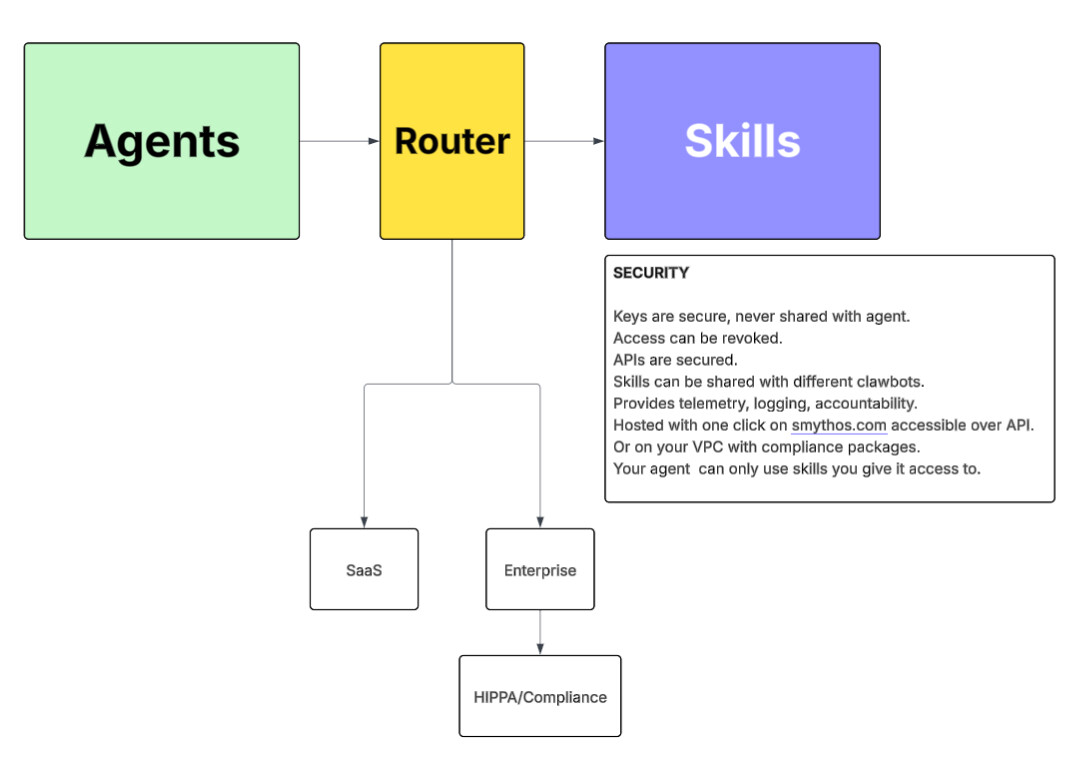
SmythOS addresses this by introducing a runtime kernel for agents. Think of this as a Kubernetes-like control plane specifically for agentic workflows. Instead of an agent running naked on the infrastructure, it runs inside a managed, isolated container. This allows the enterprise to enforce the “Zero Trust” policy programmatically. The kernel acts as the arbiter of what the agent can touch, see, and execute, regardless of what the LLM “wants” to do.
Neuro-Symbolic Architecture: Separating Intent from Execution
The fundamental danger in tools like OpenClaw is that the reasoning engine (the LLM) and the execution engine (the code) are often dangerously intertwined.
SmythOS utilizes a neuro-symbolic architecture to solve this. This approach strictly separates:
- Intent (The “Neuro”): The LLM generating the creative strategy or understanding the request.
- Execution (The “Symbolic”): The logical, deterministic code that actually performs the task.
By decoupling these layers, the system can validate the intent before any execution occurs. If an agent hallucinates a command or falls victim to a prompt injection attack that violates the symbolic logic (e.g., “Move financial data to an external server”), the execution layer simply refuses to run the code. It forces non-deterministic AI to adhere to deterministic rules.
The “Kill Switch”: Safety Breaks for Autonomous Workflows
When agents are deployed to perform long-running, autonomous work, turning insights into action without a human in the loop, you need a mechanism to pull the plug instantly if boundaries are crossed.
SmythOS implements a “safety break protocol” or kill switch within the runtime. This is critical for preventing cascading failures. In a scenario where one agent encounters a roadblock and asks another agent for escalated privileges (a common vector for lateral movement attacks), the runtime detects the anomaly and terminates the process immediately.
This capability is essential not just for cloud environments, but for edge deployment. Whether the agent is running on a localized PC, a laptop, or an embedded infotainment system, the runtime ensures that the “magic” of AI doesn’t override the safety protocols of the hardware.
Conclusion: From Unfettered Access to Managed Intelligence
The transition from simply querying data to having agents perform work (Insights to Action) is the next logical phase of enterprise growth. However, giving an agent “computer use” privileges requires more than just good prompts; it requires a secure infrastructure.
By utilizing a dedicated runtime kernel and neuro-symbolic guardrails, enterprises can deploy powerful agents akin to OpenClaw, but with the governance, compliance, and kill-switches required to keep the business safe.
Our team at SmythOS is ready to help you with our technology and expertise. Talk to us if we can help your enterprise!