
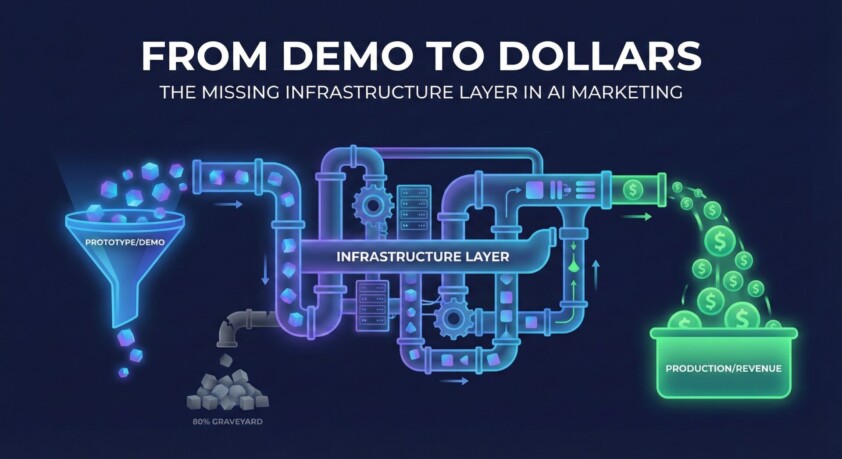

AI marketing infrastructure is the invisible backbone separating flashy demos from revenue-generating campaigns. And right now, most marketing teams are discovering this the hard way.
You know that feeling when a prototype works perfectly in the meeting room but crashes during the first real campaign? It’s not your imagination. The numbers tell a brutal story.
The Demo Graveyard Problem
According to RAND Corporation’s 2024 analysis, more than 80% of AI projects fail to reach meaningful production deployment. That’s twice the failure rate of traditional IT projects. And it gets worse.
S&P Global’s 2025 survey found that 42% of companies abandoned most of their AI initiatives this year, up from just 17% in 2024. The average organization scrapped 46% of AI proofs-of-concept before they ever reached production.
Here’s the thing. The AI models themselves aren’t breaking. GPT-4, Claude, Gemini; they work fine in isolation. What buckles is everything around them. The orchestration. The security. The governance. The infrastructure that should carry these beautiful prototypes from boardroom applause to actual business results.
Marketing teams feel this pain acutely. The global AI marketing spend is projected to hit $82 billion in 2025, yet many organizations stall between “successful pilot” and “measurable ROI.”
That’s a lot of money chasing demos that never become dollars.
Why Beautiful Prototypes Fail
The gap between prototype and production follows what industry experts call an “exponential effort curve.” Building a demo takes one unit of effort. Deploying it at enterprise scale? That takes ten. Sometimes a hundred.
Gartner predicts that over 40% of agentic AI projects will be canceled by 2027. The culprits? Escalating costs, unclear business value, and inadequate risk controls.
Marketing leaders face specific challenges that engineering teams often overlook. First, there’s the data integration nightmare. AI depends on clean, accessible, timely data. Marketing stacks are anything but clean. Customer data lives in CRMs, email platforms, analytics tools, and spreadsheets that haven’t been updated since 2019.
Then comes the security question. Marketing handles sensitive customer information. Every AI touchpoint becomes a potential compliance issue. GDPR, CCPA, the EU AI Act; these aren’t abstract concerns when your chatbot accidentally leaks customer preferences.
The third challenge is governance. Who owns the AI output? What happens when the model hallucinates a product feature that doesn’t exist? How do you audit decisions made by autonomous agents?
Most frameworks and workflow tools simply don’t address these questions. They’re designed for prototypes, not production.
What Enterprise-Grade Actually Looks Like
McKinsey’s 2025 State of AI survey revealed an interesting finding. While 78% of organizations now use AI in at least one business function, only 17% report that more than 5% of their EBIT comes from generative AI. The technology adoption is there. The revenue impact isn’t.
The difference between the 17% and everyone else? Infrastructure.
Enterprise-grade AI marketing infrastructure needs several non-negotiable components:
Kernel-level orchestration that handles failures gracefully. When an API times out or a model rate-limits, the system should recover automatically. Not crash. Not require manual intervention.
Zero-trust security built into every operation. Every agent, every process, every data access point should require explicit permission. The principle of least privilege shouldn’t be an afterthought.
Durable memory and state management. Marketing campaigns span weeks or months. Agents need to remember context, track attribution, and maintain continuity across sessions.
Deployment flexibility that matches your compliance reality. Some teams need cloud. Some need on-premise. Many need both, depending on the data sensitivity of each workflow.
According to Nucleus Research, businesses achieve an average $5.44 return for every $1 spent on marketing automation when it is properly implemented. That return requires infrastructure that actually works at scale.
The Runtime Reality Check
Think of it like building a car. You can prototype an engine in a garage. But mass production requires factories, quality control systems, supply chain management, and safety certifications. The gap between prototype and production isn’t just bigger; it’s fundamentally different.
The SmythOS Runtime Environment addresses this gap directly. By embedding orchestration to remove fragility, security to enforce governance, memory to guarantee durability, and interoperability to avoid lock-in, it delivers the missing backbone enterprises have been waiting for.
SmythOS supports deployment flexibility that matches real-world constraints. Cloud for rapid iteration. On-premise for regulated workloads. Edge deployment for latency-sensitive applications. Your business logic stays identical while infrastructure scales.
Why This Matters
The marketing automation market was valued at $6.65 billion in 2024 and is expected to reach $15.58 billion by 2030. That growth depends on organizations moving past the demo stage and into real production.
SmythOS SRE does what prototyping frameworks cannot. It delivers the infrastructure layer that transforms experiments into revenue-generating systems. By providing enterprise-grade security, flexible deployment options, and production-ready orchestration, it represents what the next generation of AI marketing infrastructure should look like.
That’s how we can move beyond the 80% graveyard and scale production. And when that shift takes hold, today’s demo-to-production struggles will feel as outdated as dial-up modems.
Your Next Move
Don’t let your AI marketing agents stall in proof-of-concept limbo. Give them the durability, governance, and portability they need with SmythOS.
Whether you’re a marketing executive ready to de-risk AI pilots, a developer looking for production-grade architecture, or a pioneer eager to help shape the future of AI marketing infrastructure, the path forward is clear.
Start by exploring the SmythOS GitHub repository and starring the project. Our team is standing by. Let us know how we can help you with your Agentic AI needs.