

Honest conversations about meaning, craft, and professional identity in the age of generative AI
Something strange is happening in creative studios and agencies worldwide. People are getting more done than ever. They’re producing work faster. And many of them feel emptier because of it.
A graphic designer recently shared his experience with researchers: “I used to take pride in my creativity. But now clients ask if I’m using AI tools, or worse, if they even need me at all. I feel like my years of hard work are being erased by a machine.”
He’s not alone. What he’s describing cuts deeper than job security. It touches on something fundamental about human identity.
The Uncomfortable Truth Nobody Talks About
Creative work was never just about the output. The struggle, the revision, the breakthrough moment after hours of grinding through bad ideas. That process mattered. It defined who we were.
Research published in Science Advances found that while AI enhances individual creativity, it reduces the collective diversity of novel content. Participants using AI produced more detailed ideas but felt less connected to them.
That disconnect is spreading. According to Anthropic’s research, 97% of creative professionals report that AI saves them time, and 68% say it has improved the quality of their work. But here’s where it gets complicated: 70% of those same creatives feel stigmatized when they use these tools. Many hide their AI usage from colleagues entirely.
Why would someone hide something that makes them more productive? Because productivity was never the point.
What We Actually Lost
AI can now do things that used to require years of skill development. It generates images, writes copy, composes music, and edits video. Tasks that once took hours now take minutes.
The Institute for the Future of Work found that 62% of workers worry AI will make their skills obsolete within five years. Of those respondents, nearly half reported feeling less confident about their future and less satisfied with their current work.
Psychologists have started calling this phenomenon “Creative Displacement Anxiety.” Research published in the Journal of Psychology and Behavior describes it as the multifaceted response to feeling overshadowed by AI-driven tools, linked to diminished well-being and an erosion of creative identity.
And yet, not everyone experiences AI this way. Some creators have discovered that their relationship with creative tools was never the whole story. The question isn’t whether AI can do what you do. The question is whether what you do was ever limited to technical execution.
The New Creative Identity
What does it mean to be creative when machines can generate endless variations of almost anything?
MIT Sloan Management Review offers a reframe. The most successful AI implementations in creative fields augment human creativity rather than replace it. This leads to a collaborative model combining technological efficiency with human intuition and emotional depth.
That emphasis on intuition isn’t marketing language. It points toward capabilities that remain distinctly human: understanding cultural context, recognizing emotional nuance, making ethical judgments, and bringing lived experience to creative decisions.
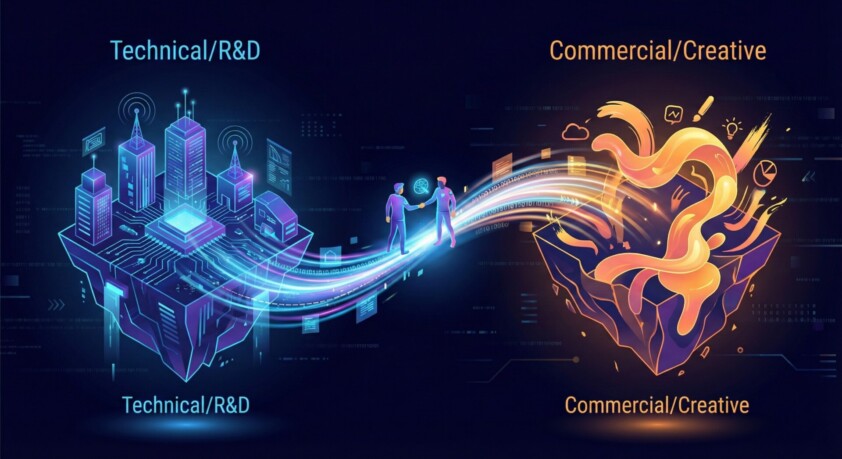
A 2025 field experiment at Procter & Gamble, led by Harvard’s D^3 Institute and reported by Fortune, revealed something unexpected. When individuals worked with AI on innovation challenges, R&D specialists began proposing more commercially viable solutions while commercial professionals developed technically sounder approaches. The AI acted as a bridge, helping team members access perspectives outside their domain expertise.
The researchers call this the emergence of the “cybernetic teammate.” For creative professionals wrestling with purpose questions, this suggests a path forward. Identity doesn’t have to be tied to being the only one who can do something. It can be tied to being the one who knows what should be done and why.
The Emotional Reality
Let’s not pretend this transition is painless. Voice actors report that certain sectors have “essentially died due to the rise of AI.” Composers worry about platforms generating infinite music, flooding markets with cheap alternatives.
These aren’t irrational fears. They’re reasonable responses to real economic pressures. The global market for generative AI in the creative sector is projected to grow from $3.08 billion in 2024 to $11.49 billion by 2029.
But creative professionals navigating this transition successfully share common characteristics. They’ve stopped defining themselves solely by technical outputs. They’ve started thinking of themselves as creative directors, even when they’re the only person in the room. They focus on vision, judgment, and meaning.
Finding Purpose in Partnership
For creatives struggling with purpose questions, researchers offer practical suggestions.
First, recognize what AI actually can’t do. It can’t understand why something matters. It can’t bring lived experience to creative decisions. It can’t take responsibility for outcomes or build genuine relationships.
Second, develop what Harvard researchers call “T-shaped” expertise. Deep vertical knowledge in your domain, combined with the ability to collaborate across other domains with AI assistance. This creates professionals who can extract maximum value from human-AI collaboration.
Third, reframe your role. Think less about producing specific outputs and more about directing creative processes toward meaningful outcomes. This shift from craftsperson to creative director isn’t about abandoning craft. It’s about expanding the meaning of craft.
Research from ACM Transactions on Interactive Intelligent Systems found that designers who began with traditional brainstorming before incorporating AI demonstrated greater agency and achieved better results than those who relied solely on AI from the start. The tool didn’t determine the outcome. The human approach to using the tool did.
Why This Matters
The question of whether creatives can find purpose in AI-assisted work isn’t just about creative professionals. It’s about how humans maintain meaning when technology automates tasks we once considered essentially human.
Frameworks make automation accessible. However, they don’t address the deeper issue of integrating these capabilities while preserving what makes work meaningful.
SmythOS approaches this differently. The Agent Studio empowers creative professionals to control how AI integrates into their workflows. You decide what tasks to automate and which to protect. You maintain creative direction while leveraging computational efficiency through agent collaboration capabilities. The human remains the intelligent operator, with AI serving as powerful tools within a larger workflow you design and deploy yourself.
That’s a crucial difference. It’s the difference between being displaced by technology and being empowered by it.
What Comes Next
The creative industries aren’t going back to how things were. But the future isn’t predetermined either. Creative professionals who approach this transition thoughtfully, who protect what matters while embracing what helps, and who redefine their identity around judgment and meaning are the ones most likely to thrive.
It won’t be easy. Purpose rarely comes without struggle. But the struggle itself might be part of what makes the work meaningful.
And that’s something AI can’t replicate.
Ready to build AI workflows that augment your creativity rather than replace it?
Talk to our team about how SmythOS can help you maintain creative direction while leveraging AI agents.
Join other developers building the future of human-AI collaboration.
Star our SmythOS GitHub repository.
Our team is standing by. Let us know how we can help you with your Agentic AI needs.